

How to Identify an Electric Oven Problem: Common Signs and Quick Checks
 Dec, 7 2025
If your electric oven isn't heating right, takes forever to preheat, or shuts off randomly, you’re not alone. Thousands of homeowners in Toronto and beyond face the same frustration every winter. Before you call a technician or buy a new oven, you can often spot the problem yourself with a few simple checks. Most electric oven issues aren’t expensive to fix-once you know what to look for.
Is the oven completely dead?
First, check if the oven does anything at all. No display, no lights, no beeps? That usually means no power is reaching the unit. Start at the source: make sure the circuit breaker hasn’t tripped. Electric ovens draw a lot of power, so they’re on their own 240-volt circuit. Go to your breaker panel and look for a double-pole switch labeled "Oven" or "Range." If it’s flipped to the middle or off position, reset it. If it trips again right away, there’s a serious short circuit-you’ll need a professional.
Also check the outlet. Some older homes have wall outlets for ovens instead of hardwired connections. Plug in another high-wattage appliance, like a space heater, to test if the outlet works. If it doesn’t, the issue is with the wiring or the outlet itself.
Is the oven heating unevenly or too slowly?
If the oven turns on but takes 30 minutes to reach 350°F-or the bottom burns while the top stays raw-you’ve got a heating element problem. Electric ovens use two main elements: the bake element (bottom) and the broil element (top). The bake element does most of the work during regular cooking.
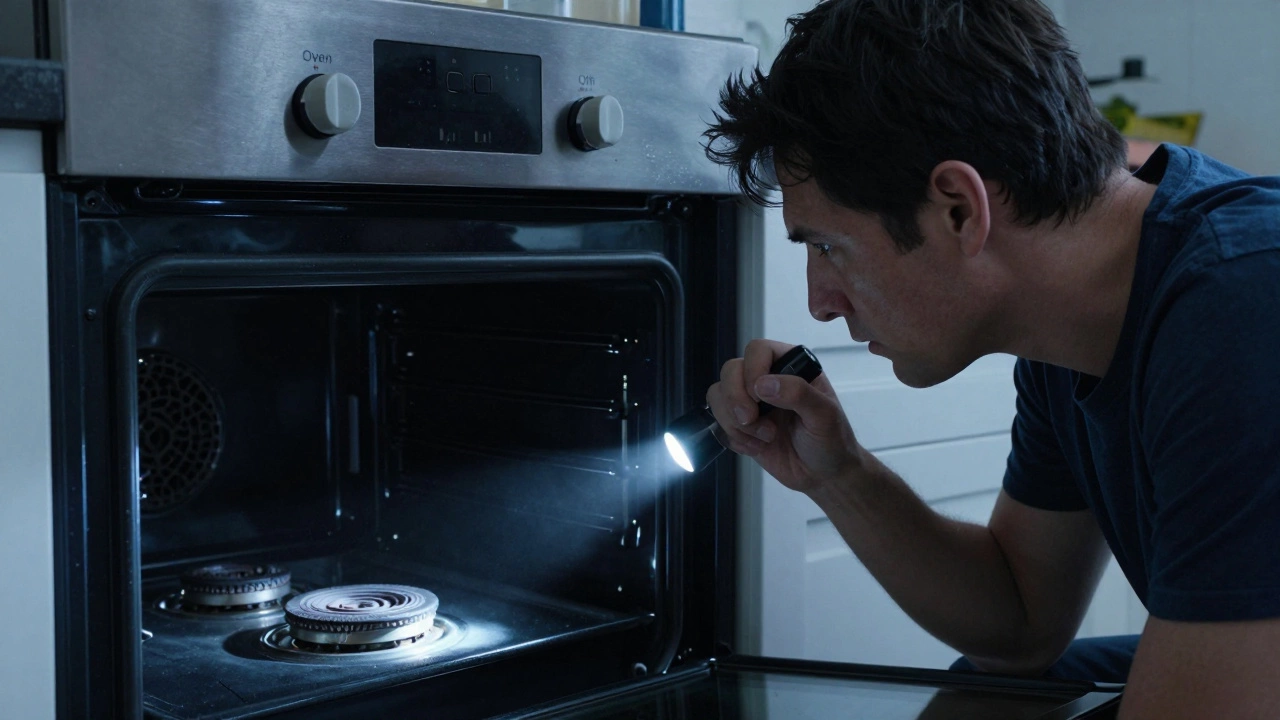
Turn the oven on to 350°F and watch the bottom element. It should glow bright orange within a few minutes. If it stays dark, it’s likely burned out. You can also pull the oven out (unplugged!) and inspect the element visually. Look for cracks, blisters, or sections that are burnt black. A broken element might even sag or fall off its mounts.
Replace it yourself. Bake elements cost between $30 and $70, and installation takes under an hour. Just unplug the oven, remove the screws holding the element, disconnect the wires, and swap it out. Make sure the replacement matches the wattage and shape of the old one.
Why does the oven turn off before reaching the right temperature?
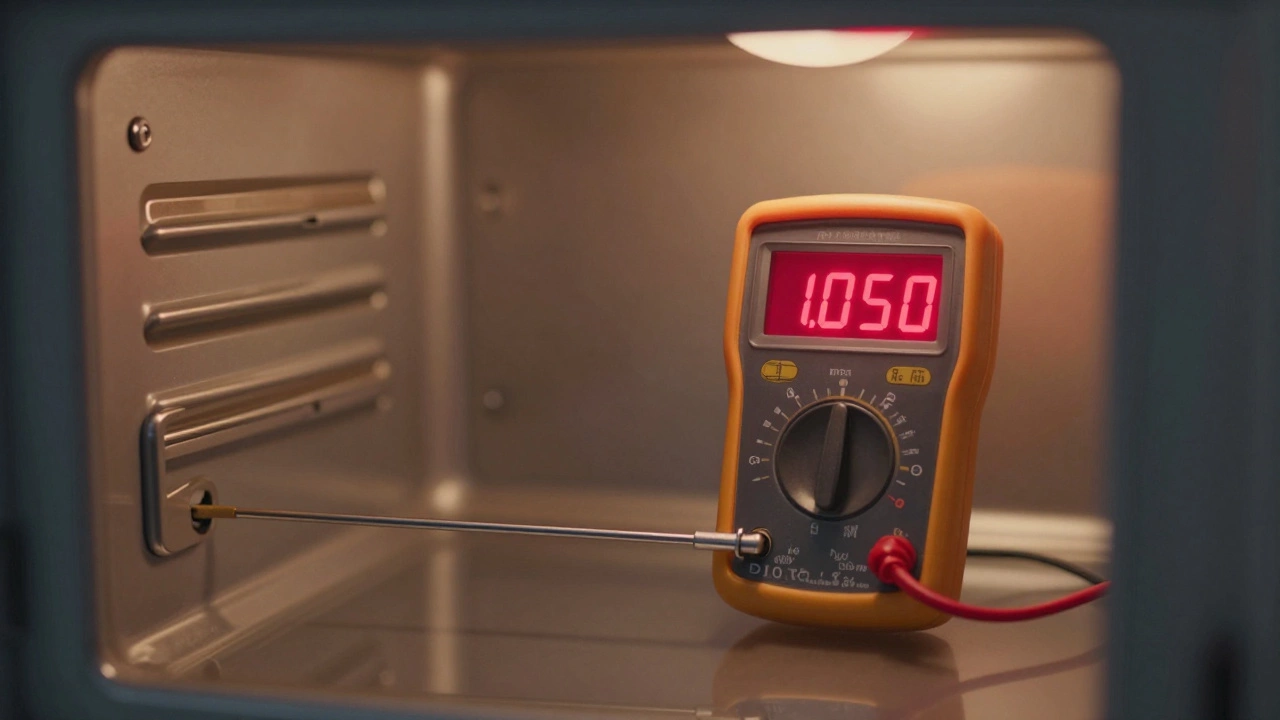
This is usually a thermostat or temperature sensor issue. The sensor is a thin metal probe, usually located on the back wall of the oven. It measures the air temperature and tells the control board when to turn the heating elements on and off.
If the sensor is faulty, it sends wrong signals. Your oven might think it’s already at 350°F when it’s only at 250°F. The result? Food undercooks. To test it, you need a multimeter. Set it to measure resistance (ohms). Unplug the oven, remove the sensor (usually held by two screws), and touch the multimeter probes to the two terminals. At room temperature (around 70°F), it should read between 1,000 and 1,100 ohms. If it reads way higher or shows no reading at all, the sensor is bad.
Replacement sensors cost $25 to $50. You can find the exact part number by checking your oven’s model tag-usually inside the door frame or on the side of the oven cavity.
Why does the oven light come on but nothing heats up?
If the interior light works but the oven doesn’t heat, the problem is likely in the control board or a relay that powers the heating elements. The light runs on 120 volts, while the heating elements need 240 volts. So if the light works, you know the oven is getting some power-but not enough to activate the elements.
Control boards fail often in older ovens (10+ years), especially in places with unstable voltage like Toronto, where winter storms can cause power surges. If you’ve ruled out the elements and sensor, the control board is the next suspect. Unfortunately, you can’t test it without specialized tools. But if your oven is older and other fixes didn’t work, replacing the control board might be your best bet. Prices range from $150 to $300, depending on the brand.
Is the oven door seal damaged?
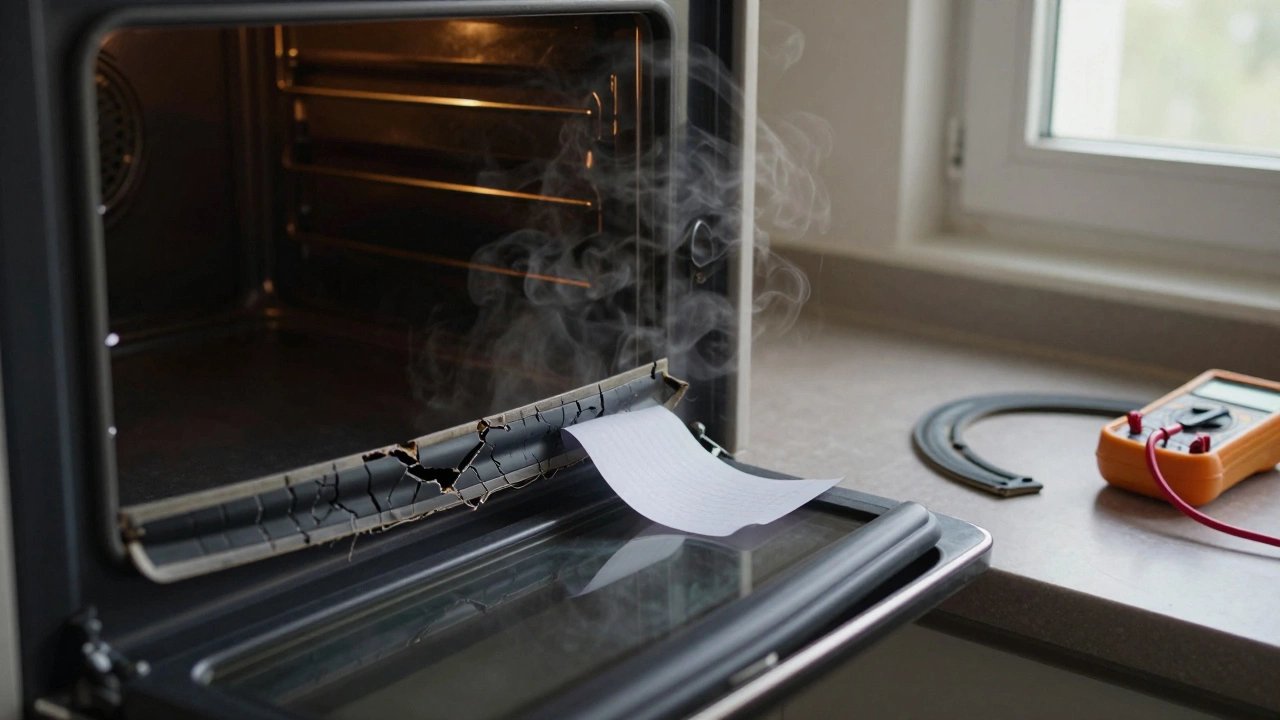
A broken door seal lets heat escape, making the oven work harder and longer to maintain temperature. You might notice the door feels hot to the touch even when the oven is off. Or you see smoke or steam leaking around the edges when it’s running.
Check the gasket-the rubbery strip around the door. Look for cracks, brittleness, or gaps. If you can slip a piece of paper between the door and the frame and pull it out easily, the seal is no longer tight. Replacement gaskets cost $20 to $40 and snap into place. Don’t ignore this. A bad seal can increase your electricity bill by 15% to 20% over time.
Why does the oven make strange noises?
Clicking or popping sounds during preheat are normal-that’s the relay switching the elements on and off. But if you hear loud buzzing, grinding, or rattling, something’s wrong. A faulty fan motor (in convection ovens) can make grinding noises. If your oven has a convection fan, turn it on and listen. If the fan spins slowly or makes noise, the motor might be failing.
Another cause: loose components. Over time, screws holding the heating element or fan housing can loosen. Turn off the power and remove the back panel (if you’re comfortable). Tighten any loose screws. If the noise continues, the motor or fan blade may need replacing.
What about error codes?
Modern electric ovens display error codes like F1, E3, or E5. These aren’t random-they’re diagnostic tools built into the control system. Look up your oven’s brand and model number online to find what each code means. For example:
- F1 on a Whirlpool oven usually means a faulty control board.
- E3 on a GE oven often points to a temperature sensor failure.
- F5 on a Frigidaire oven can mean a door lock issue.
Don’t guess. Use the code to narrow your search. Many manufacturers list error code guides on their support sites. If you can’t find yours, search "[your brand] oven error code [number]" on Google. You’ll often find repair forums or videos showing exactly what to do.
When should you call a professional?
You can fix most electric oven problems yourself-unless you’re dealing with wiring, gas lines, or control boards. If you’re uncomfortable working with electricity, don’t risk it. Also, if the oven is under warranty, opening it up might void coverage. And if your oven is over 15 years old, consider replacement. Newer models are 30% more energy-efficient and come with better safety features.
But if you’ve checked the elements, sensor, door seal, and error codes-and everything looks fine-it’s time to call a certified appliance technician. They have the tools to test voltage, diagnose control boards, and spot hidden faults you can’t see.
Quick checklist: What to check first
- Is the circuit breaker tripped? Reset it.
- Does the bake element glow when the oven is on? If not, it’s likely broken.
- Is the temperature sensor reading correctly? Test with a multimeter.
- Is the door seal intact? Try the paper test.
- Are there error codes on the display? Look them up.
- Does the oven turn on but not heat? Check the control board.
Most electric oven problems are simple and cheap to fix. You don’t need to be an electrician-just patient and careful. Take your time. Unplug the oven before you touch anything. And always match replacement parts exactly. A wrong element or sensor can cause more damage.