

What Would Cause an Oven to Not Heat Up? Common Fixes for Electric and Gas Ovens
 Mar, 5 2026
Oven Heating Troubleshooter
Let's diagnose your oven issue
Answer these questions to identify the most likely cause and recommended action.
Recommended Solution
Nothing kills a Sunday roast faster than turning on your oven and realizing it’s not heating up. You set the temperature, wait ten minutes, and there’s no warmth. No smell of preheating. No sound of the fan spinning. Just silence. If you’ve been there, you know how frustrating it is-especially when you’re on a schedule or feeding a crowd. The good news? Most oven heating problems aren’t expensive to fix, and many are DIY-friendly. Here’s what’s likely going wrong and how to check it yourself.
Your heating element might be dead
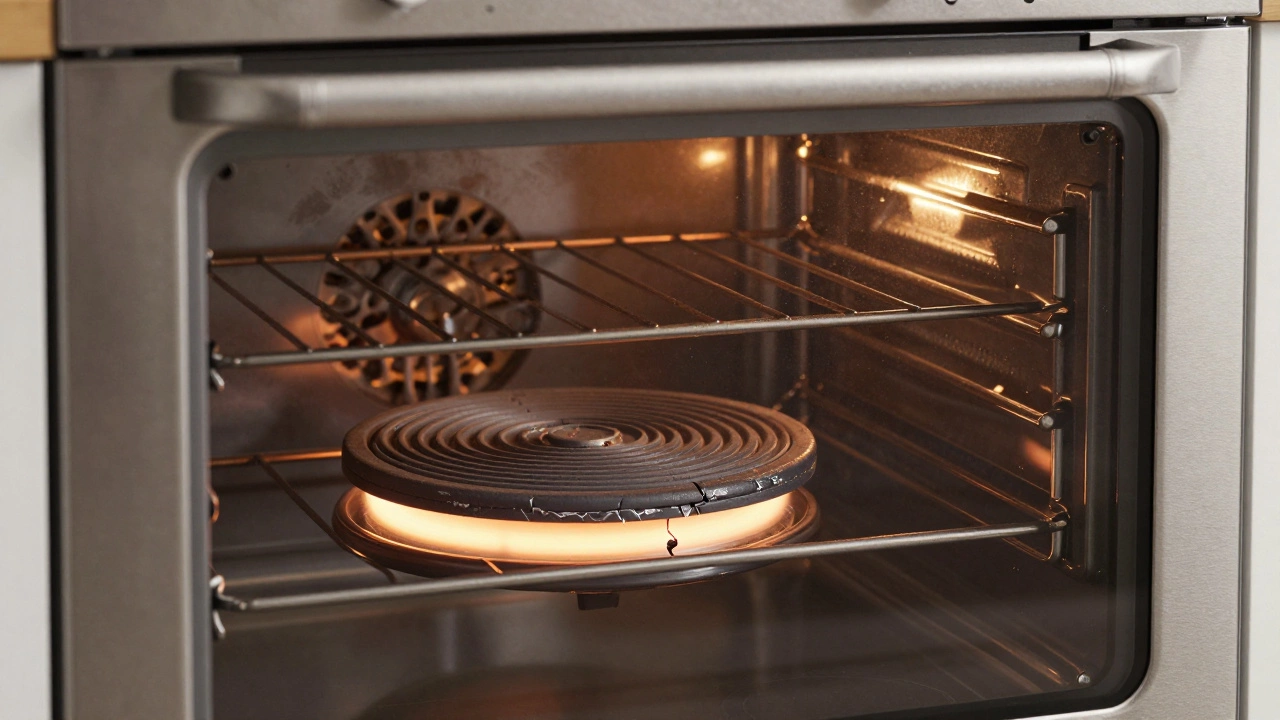
For electric ovens, the heating element is the most common culprit. It’s the metal coil at the top and bottom of the oven cavity. When it works, it glows red-hot. If it’s broken, it might look dark, cracked, or have a broken section. Sometimes, it’s not even visible because the damage is internal. You can’t always tell just by looking. The easiest way to confirm is to turn the oven on to 350°F and watch closely. If the bottom element doesn’t glow at all, or the top broil element stays dark, one of them has failed.
Heating elements wear out over time. Most last 5 to 10 years, depending on usage. If your oven is older than seven years and this is the first time it’s stopped heating, that’s a strong clue. Replacing it is straightforward: unplug the oven or shut off the circuit breaker, remove the two screws holding the element in place, pull it out, unplug the wires, and swap in the new one. Parts cost between $25 and $50. You can find the right model by checking your oven’s serial number and matching it online.
The thermostat is lying to you
Here’s a sneaky one: your oven might be heating, but the thermostat isn’t reading the temperature right. It thinks the oven is already hot when it’s not. That’s why the element turns off early. You’ll see the display say 350°F, but the inside might only be 200°F. This is common in older models or ovens that have been exposed to steam or grease buildup over time.
There’s no easy visual test for this. But you can confirm it with a simple trick. Grab an oven-safe thermometer (the kind used for baking, not meat). Place it in the center of the middle rack. Set the oven to 350°F and let it preheat for 20 minutes. If the thermometer reads more than 25°F off, your thermostat is likely faulty. Replacing it costs $40 to $80, depending on the brand. Some ovens let you recalibrate the thermostat through the control panel-check your manual. If it’s a digital oven, the issue could be a failed sensor instead.
Broken oven sensor (electric ovens)
Modern electric ovens use a temperature sensor-a thin metal rod usually mounted on the back wall near the top. It tells the control board how hot the oven is. If this sensor is dirty, bent, or broken, it sends wrong signals. A faulty sensor often causes the oven to heat unevenly, shut off too soon, or not heat at all.
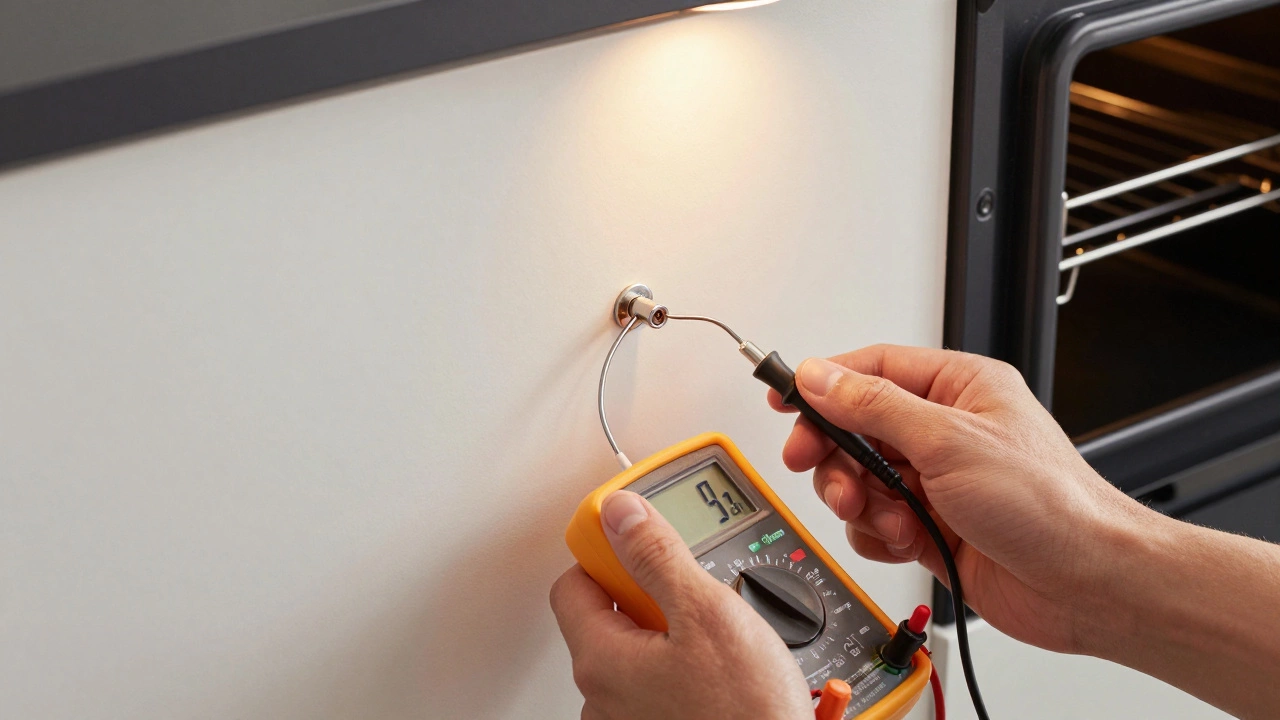
To test it, unplug the oven and locate the sensor. It’s usually held in place by two screws. Remove it and use a multimeter to check resistance. At room temperature (around 70°F), it should read between 1,000 and 1,100 ohms. If it reads way higher (like 2,000+) or shows no reading at all, it’s bad. Replacement sensors cost $30 to $60. You can buy them by matching your oven’s model number. A bent sensor can also cause problems. If it’s touching the oven wall, it will give false readings.
Gas oven? Check the igniter first
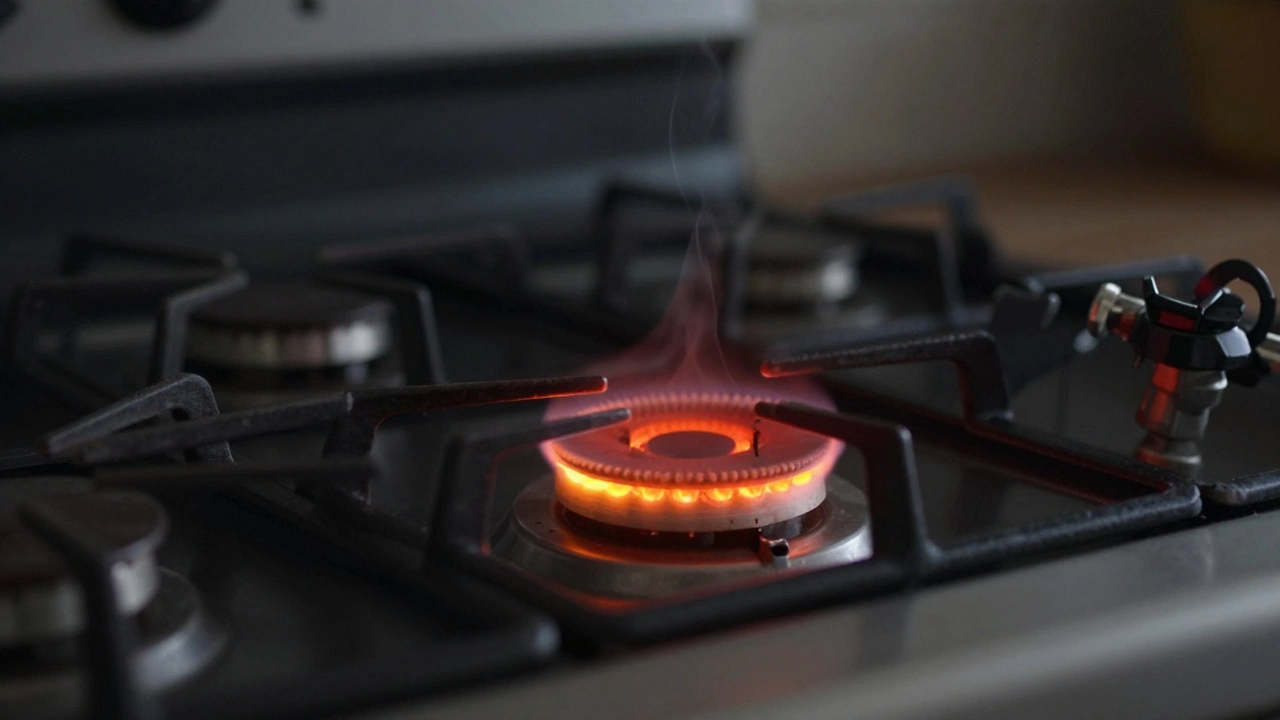
If you have a gas oven and it’s not heating, the igniter is usually the problem. The igniter is a small ceramic device that glows red-hot to ignite the gas. If it’s weak, it won’t get hot enough to open the gas valve. You might hear a clicking sound, but no flame. Or worse, you smell gas but never see a fire.
A working igniter glows bright orange within 30 to 60 seconds. If it glows dimly, takes longer than a minute, or doesn’t glow at all, it’s failing. Even if it glows, it might not draw enough current to open the safety valve. You can test it with a clamp meter-most good igniters pull 3.2 to 3.6 amps. If it’s under 3 amps, replace it. New igniters cost $40 to $70. Always turn off the gas before replacing it. Don’t try to force it-gas leaks are dangerous.
Gas valve or regulator failure
If the igniter glows fine but you still don’t get a flame, the gas valve might be stuck. This is less common but more serious. The valve controls gas flow to the burner. If it’s clogged with debris, corroded, or mechanically broken, no gas reaches the burner. You might smell gas briefly when you turn the oven on-that’s a red flag. Don’t ignore it. Turn off the gas supply and call a professional.
Regulators can also fail. They control pressure from the gas line. If pressure drops too low, the oven won’t light. This is more common in older homes with aging gas lines or after a utility work incident. If your stove top works fine but the oven doesn’t, the problem is likely isolated to the oven’s gas valve or regulator-not the main supply.
Tripped circuit breaker or blown fuse
Electric ovens use 240 volts and draw a lot of power. If the circuit breaker trips, the oven won’t heat. It might still have power for the light or display, but not for the heating elements. Check your home’s breaker panel. Look for a double-pole breaker (two switches side by side) labeled "Oven" or "Range." If it’s halfway off, flip it fully off, then back on. If it trips again immediately, there’s a short circuit. Don’t keep resetting it-that’s a fire risk.
Older homes with fuse boxes might have a blown fuse instead. Look for a glass or ceramic fuse that’s blackened or has a broken wire inside. Replace it with the exact same amperage (usually 30 or 40 amps). Never use a higher-rated fuse. If you’re not sure, call an electrician.
Control board failure
The control board is the oven’s brain. It tells the heating elements when to turn on. If it’s damaged by a power surge, moisture, or age, it won’t send the right signals. Signs include: no display, erratic temperature changes, or the oven turning on by itself. You might also see error codes like "F1," "F3," or "E1" on digital displays.
Testing a control board isn’t something most homeowners can do. It requires a multimeter and wiring diagrams. If all other parts check out-element, sensor, thermostat-and the oven still doesn’t heat, the board is the likely culprit. Replacing it costs $150 to $300. For older ovens (over 10 years), it’s often cheaper to replace the whole unit than to fix the board.
Door switch malfunction
It sounds crazy, but a broken door switch can stop an oven from heating. This safety feature prevents the oven from turning on if the door isn’t fully closed. If the switch is stuck, dirty, or broken, the oven thinks the door is open-even when it’s shut. You might notice the light stays on when the door closes, or the oven makes a faint clicking noise but never heats.
To test it, unplug the oven and locate the switch near the door frame. It’s usually a small plastic button. Press it manually while the oven is set to heat. If the element turns on when you hold it down, the switch is faulty. Replacement switches cost $15 to $30. They’re easy to swap: just unplug the wires, remove the old one, and plug in the new.
When to call a professional
You can fix most oven heating problems yourself. But call a technician if:
- You smell gas and the oven won’t light
- The circuit breaker keeps tripping
- You see sparks, smoke, or burning smells
- The control board is displaying error codes you can’t look up
- You’re uncomfortable working with electricity or gas
Gas leaks and electrical shorts can be deadly. Even if you’re handy, safety comes first. In Toronto, many appliance repair services offer same-day oven diagnostics. A professional can usually diagnose the issue in under 30 minutes and give you a quote before any work begins.
Prevent future problems
- Keep the oven clean. Grease buildup can damage sensors and elements.
- Don’t use harsh cleaners on the heating elements. They’re delicate.
- Use oven-safe thermometers to verify temperature accuracy.
- Replace worn-out door seals-they help retain heat and protect the switch.
- Install a surge protector for your oven if you live in an area with frequent power spikes.
Most ovens last 12 to 15 years. If yours is older and you’re replacing parts often, it might be time to upgrade. Newer models are more energy-efficient and have better diagnostics built in. But if it’s still under 10 years old, fixing it is almost always worth it.
Why does my electric oven turn on but not heat up?
If the oven turns on but doesn’t heat, the heating element is likely broken. Check if the bottom or top element glows red when the oven is set to bake. If neither glows, test the element with a multimeter for continuity. If there’s no electrical path, replace it. Also check the oven sensor and thermostat-they can cause similar symptoms.
Can a dirty oven cause it not to heat?
Yes. Heavy grease or food debris can block airflow, trap heat, or interfere with the temperature sensor. If the sensor is covered in gunk, it reads the temperature wrong and shuts off the heating element early. Clean the oven regularly with mild cleaners-never spray directly on heating elements or sensors.
My gas oven smells like gas but doesn’t light. What should I do?
Turn off the gas supply immediately and open windows. Do not use any switches, phones, or electronics near the oven. The igniter may be weak, or the gas valve may be stuck. Either way, this is a gas leak risk. Call a licensed technician or your gas provider. Do not attempt to fix it yourself.
Is it cheaper to repair or replace a broken oven?
If your oven is under 10 years old and the repair cost is less than half the price of a new one, fix it. Replacing a heating element or igniter costs under $100. Control boards and gas valves can run $200-$300. If your oven is older than 12 years, replacement is usually more cost-effective. New models are 20-30% more energy-efficient.
Why does my oven heat unevenly?
Uneven heating usually means one heating element is weaker than the other, or the oven sensor is dirty or misaligned. Check both elements for damage. Use an oven thermometer to test temperature accuracy. If one side of the oven is hotter, the fan might be failing (in convection models) or the door seal is leaking heat.