

How to Tell if a Hot Water Heater Element Is Bad
 Feb, 8 2026
Water Heater Element Tester
This tool helps you determine if your electric water heater element is working properly based on your multimeter readings.
If your hot water suddenly turns cold or only lasts a few minutes, chances are one of your electric water heater’s elements has gone out. It’s not a mystery you need a technician to solve-most homeowners can diagnose this themselves with a simple multimeter and a little patience. No fancy tools. No guesswork. Just clear steps to find out if the element is the problem.
Understand how your electric water heater works
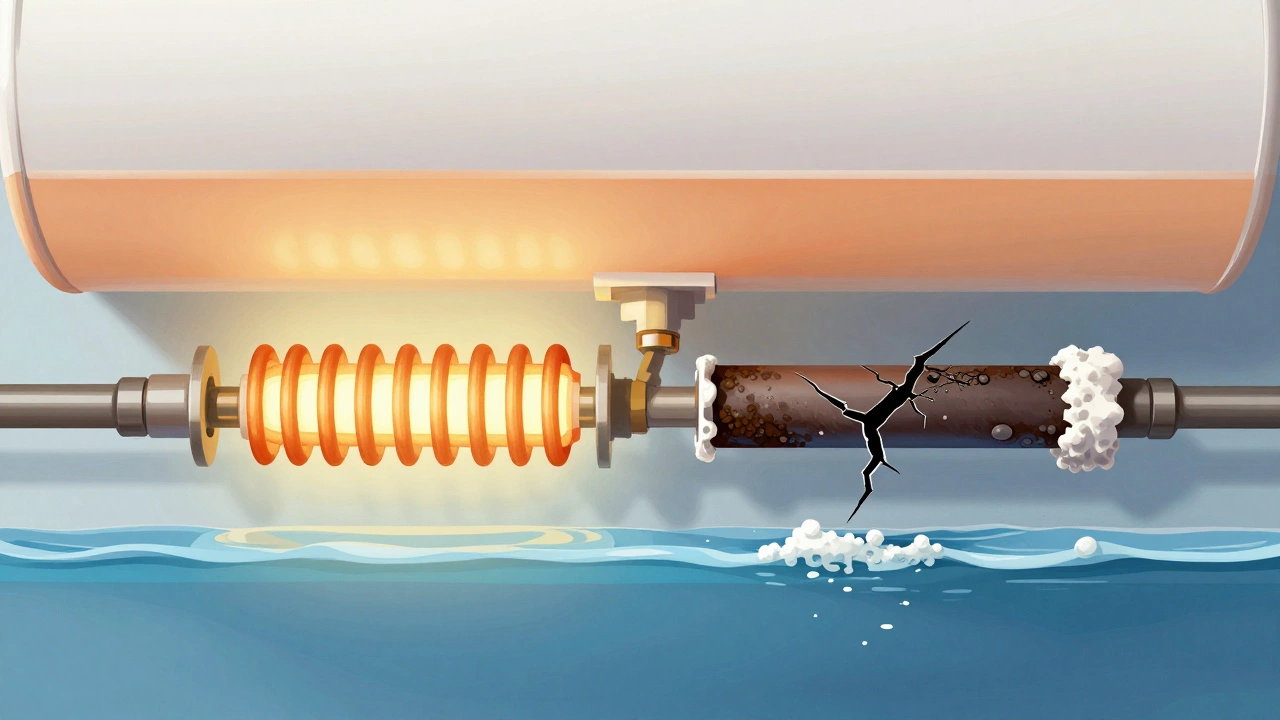
Most homes in Toronto and across North America use electric water heaters with two heating elements: one near the top and one near the bottom. The top element heats water first, and once it reaches the set temperature, the bottom element kicks in to maintain the supply. If either one fails, you’ll notice problems. A bad top element means you get no hot water at all. A bad bottom element means you get a small amount of warm water before it runs out.These elements are simple: a metal tube with a resistance coil inside. When electricity flows through, the coil heats up. Over time, mineral buildup from hard water, power surges, or just age can cause the coil to break. When that happens, no heat is produced-even though the light might still turn on.
Signs your water heater element is bad
Before you grab a multimeter, look for these clear red flags:- No hot water at all (both elements likely failed)
- Hot water runs out after just a few minutes (bottom element is faulty)
- Water is lukewarm but never gets fully hot
- Strange noises like popping or crackling from the tank
- Water heater trips the circuit breaker frequently
If you see any of these, especially in a home with hard water (common in Ontario), the element is the prime suspect. Don’t assume it’s the thermostat. Elements fail far more often.
Turn off power before you start
This isn’t optional. Water and electricity don’t mix. Even if the water heater looks off, it could still be live.- Go to your main electrical panel.
- Find the double-pole breaker labeled "Water Heater" or something similar-it’s usually 30 or 40 amps.
- Flip it to OFF.
- Double-check with a non-contact voltage tester near the heater’s access panels. If it beeps, the power is still on. Keep looking.
Also, shut off the cold water supply valve at the top of the tank. Open a hot water faucet in the house to relieve pressure. This keeps water from spraying out when you remove the element.
Gather what you need
You only need two things:- A multimeter (digital is fine, $15 from any hardware store)
- A screwdriver (flathead or Phillips, depending on your panel)
No special tools. No need to drain the tank. You’re not replacing the element yet-just testing it.
Locate and remove the access panels
Most electric water heaters have two access panels on the side-upper and lower. Each hides a thermostat and an element.- Remove the metal cover on the top panel using a screwdriver.
- Beneath it, you’ll see a plastic insulation cover. Peel it back carefully.
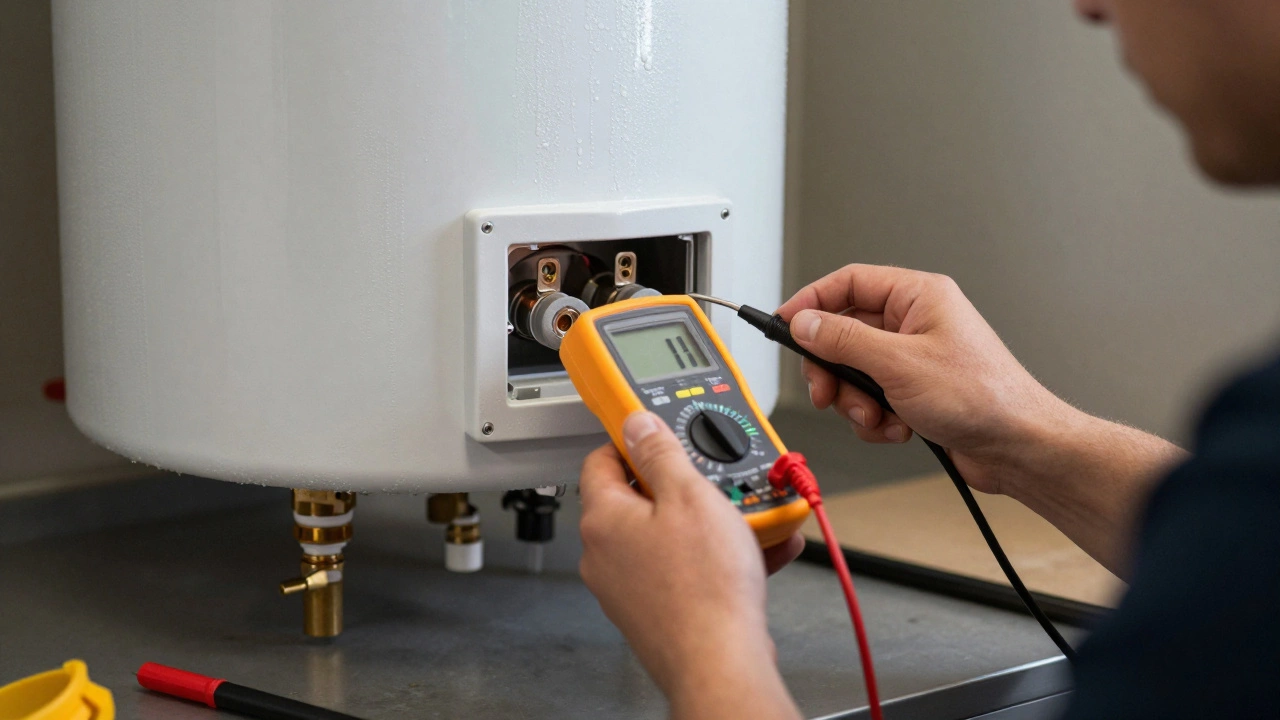
- Underneath, you’ll find two metal terminals connected to the element. That’s what you’ll test.
- Repeat for the lower panel.
Don’t touch the wires. Just note their positions so you can reconnect them later.
Test the element with a multimeter
Set your multimeter to the lowest ohms (Ω) setting-usually 200Ω.- Place one probe on each of the two metal terminals on the element.
- Watch the reading.
Here’s what the numbers mean:
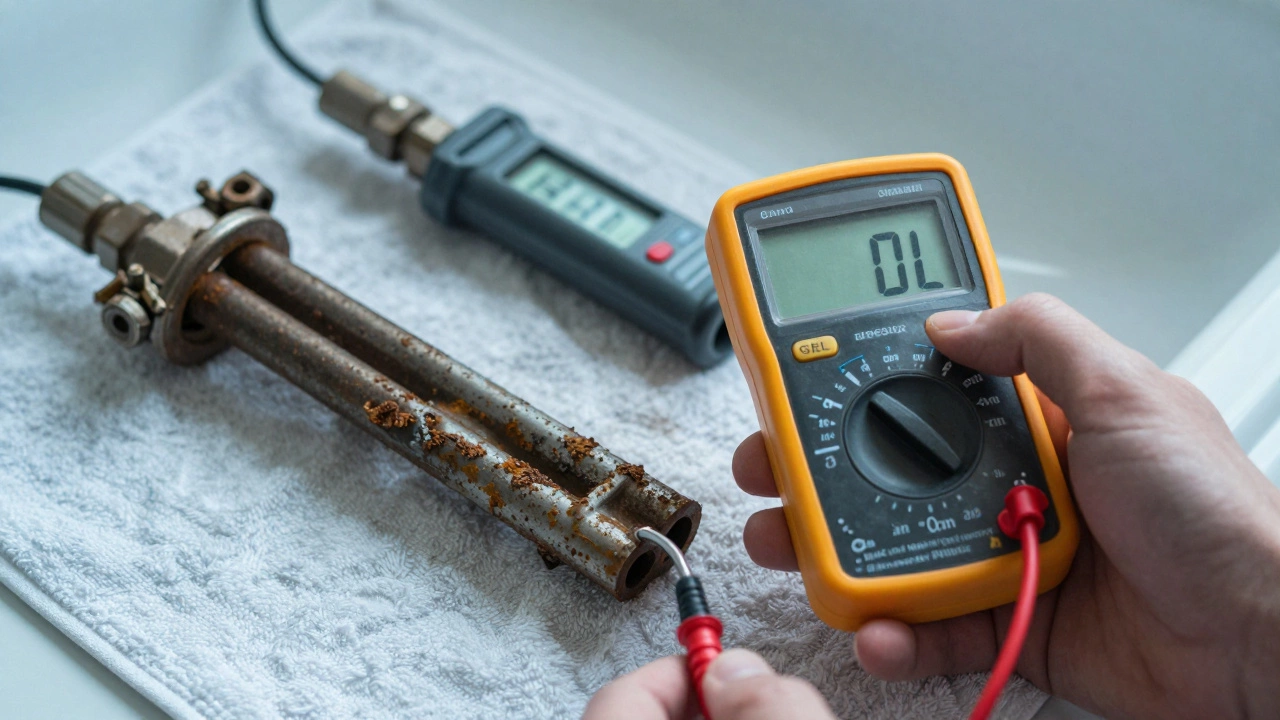
- Between 10 and 16 ohms → Element is good. It’s conducting electricity properly.
- Zero ohms (0) → Short circuit. The element is dead.
- Infinite ohms (OL or 1) → Open circuit. The coil is broken. Element is bad.
Most 4500-watt elements read around 12-14 ohms. If yours reads 8 or 18, it’s still fine-manufacturers allow a ±10% tolerance. But anything outside 10-16 is a red flag.
Now, test for grounding. Put one probe on a terminal and the other on the metal tank. If you get any reading at all-even 1 ohm-the element is leaking current to the tank. That’s dangerous. Replace it immediately.
What if both elements test fine?
If both elements show normal resistance and no grounding, the problem might be the thermostat. But that’s less common. A bad thermostat usually means one element won’t activate at all, even if it’s healthy.Here’s a quick way to check: after testing the elements, turn the power back on briefly (only 30 seconds) and feel the tank. If the top half is hot but the bottom is cold, the lower thermostat likely isn’t triggering the lower element. Replace the thermostat next.
Replace the element if needed
If you confirmed a bad element, you’ll need to replace it. Buy a replacement that matches the wattage (usually 4500W or 3800W) and voltage (240V). Most are universal, but check the label on the old one.- Drain the tank until water is below the element.
- Unscrew the old element using a socket wrench.
- Scrape off old plumber’s tape or sealant from the threads.
- Wrap new Teflon tape around the threads of the new element.
- Thread the new element in by hand, then tighten with the wrench-don’t over-torque.
- Refill the tank completely before turning power back on.
Failure to refill the tank first? You’ll burn out the new element in seconds. Always fill first. Always.
Prevent future failures
Hard water is the #1 killer of water heater elements. In Toronto, many homes have water with high calcium and magnesium levels.- Flush your tank once a year-drain a few gallons through the spigot to remove sediment.
- Install a water softener if you notice scale buildup on faucets or showerheads.
- Set your thermostat to 120°F (49°C). Higher temps speed up mineral buildup and wear out elements faster.
- Consider a hybrid or heat pump water heater-they last longer and use less electricity.
Most electric water heaters last 8-12 years. If yours is older than 10 and you’re replacing elements often, it’s time to think about a full replacement.
When to call a pro
You don’t need to be an electrician to test or replace an element. But if you’re uncomfortable with:- Working near live wires
- Draining or refilling the tank
- Reading a multimeter
…then call a licensed plumber. A bad element is a simple fix-but safety comes first.
How do I know if my water heater element is bad?
If you get little to no hot water, or it runs out quickly, the element is likely bad. Test it with a multimeter: a reading of zero or infinite ohms means it’s failed. A good element reads between 10 and 16 ohms. Also, if you get any reading when testing between a terminal and the metal tank, the element is grounded and unsafe.
Can I test a water heater element without draining the tank?
Yes. You don’t need to drain the tank to test the element. Just turn off the power, remove the access panel, and use a multimeter on the terminals. Drain only if you’re replacing the element.
What causes a water heater element to go bad?
The most common cause is mineral buildup from hard water, which coats the element and causes it to overheat and burn out. Power surges, age, and running the heater with low water levels also contribute. In areas like Toronto with hard water, elements often fail after 5-8 years.
Is it cheaper to fix or replace a water heater?
If your water heater is under 8 years old and you’re only replacing one element, fixing it is cheaper. A new element costs $20-$40. But if the tank is rusty, leaking, or over 10 years old, replacement is better. A new unit lasts 10-15 years and saves on energy bills.
Can I replace just one element if both are bad?
Technically, yes-but it’s not recommended. If one element fails, the other is likely near the end of its life too. Replacing both at once saves time, money, and avoids another repair in a few months. Always replace them as a pair.